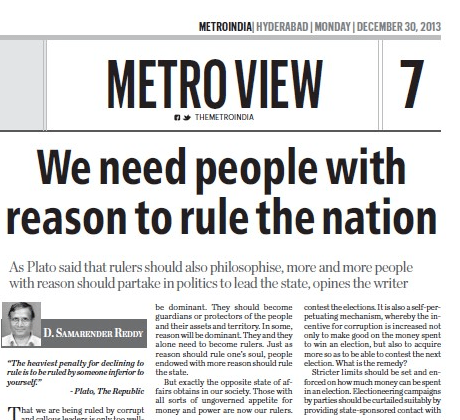
(The following article of mine was first published in Metro India, an English daily newspaper from Hyderabad, on December 30, 2013, under the title “We need people with reason to rule the nation”)
“The heaviest penalty for declining to rule is to be ruled by someone inferior to yourself.”
- Plato, The Republic
That we are being ruled by corrupt and callous leaders is only too well-known to the readers. All they seem to care about is lining their pockets and wielding power to further their own selfish ends, and having an eye always on winning the next election, come what may. The results of such leadership are all too obvious. Plato, a Greek philosopher, warned about this problem way back in 4th century BC. Let us see what he had to say on what qualities a leader or ruler should possess to be capable of discharging that role properly.
Plato conceived the state as being “man writ large.” That is to say, the structure of man’s psychological being or soul (or nature, if you will), Plato felt, was mirrored in the structure of the state or civil society. Man, he theorized, had three components or springs of action in his soul. This tripartite structure comprised the appetite (desire for things), spirit (drive toward action), and reason (awareness and discrimination of goals and values).
Plato gives the analogy of a chariot being pulled by two unruly horses (representing appetite and spirit), and being driven by a charioteer (representing reason). One of the horses (representing spirit) is controlled by words and admonition only, but the other horse (representing appetite) needs a whip and spur to be controlled. Unless the charioteer exercises control over the two horses, he will be in for a very bad ride. Similarly, unless reason rules over the appetitive and spirited parts of one’s soul, one misses the boat, so to speak.
In some, the appetite part will be dominant. They are better suited to be craftsmen or producers of goods and commodities needed by the members of a society. In some, the spirited part will be dominant. They should become guardians or protectors of the people and their assets and territory. In some, reason will be dominant. They and they alone need to become rulers. Just as reason should rule one’s soul, people endowed with more reason should rule the state.
But exactly the opposite state of affairs obtains in our society. Those with all sorts of ungoverned appetite for money and power are now our rulers. And those endowed with more reason have become mere producers and do not take part at all in politics. Until reason holds sway over appetite, the state will come to ruin. As Plato put it eloquently, philosophers should be kings (that is, rulers) and kings should philosophize.
As I see it, there are two main barriers to people endowed with more reason participating in politics in India: (1) the amount of money that needs to be spent to win an election, and (2) the uncertainty of continuing to win elections, making it unattractive as a career. Both those barriers mean that only people or parties with money to throw around contest the elections. It is also a self-perpetuating mechanism, whereby the incentive for corruption is increased not only to make good on the money spent to win an election, but also to acquire more so as to be able to contest the next election. What is the remedy?
Stricter limits should be set and enforced on how much money can be spent in an election. Electioneering campaigns by parties should be curtailed suitably by providing state-sponsored contact with the electorate, through print, TV and electronic media, and other publicity outlets. Anyone who has served even one term in an elected office should be offered lifelong minimum guaranteed monthly income for services rendered so that they can weather the periods when they lose the election (though Plato would have them be rulers for life without having a family or owning private property). Such measures would lead to better people entering politics, and we would be ruled by philosopher-kings.