In clinical psychology, emotional vulnerability refers to a temperament in which a person is unusually sensitive to emotional stimuli, reacts to them intensely, and takes a long time to return to baseline afterwards. The idea is central to Marsha Linehan’s biosocial theory of borderline personality disorder, on which dialectical behavior therapy is built. In that theory, lasting problems with emotion regulation develop when a child born with this vulnerability grows up in an “invalidating environment” that dismisses, punishes, or reacts unpredictably to displays of private emotional experience. Researchers in personality psychology describe high neuroticism in similar terms, as a broad emotional vulnerability that raises the risk of later anxiety and mood disorders.
Research on close relationships treats the willingness to be emotionally vulnerable with another person as one of the main ways intimacy develops. In Reis and Shaver’s interpersonal process model, intimacy grows when one partner’s self-disclosure is met with a response the discloser experiences as understanding, validating, and caring.
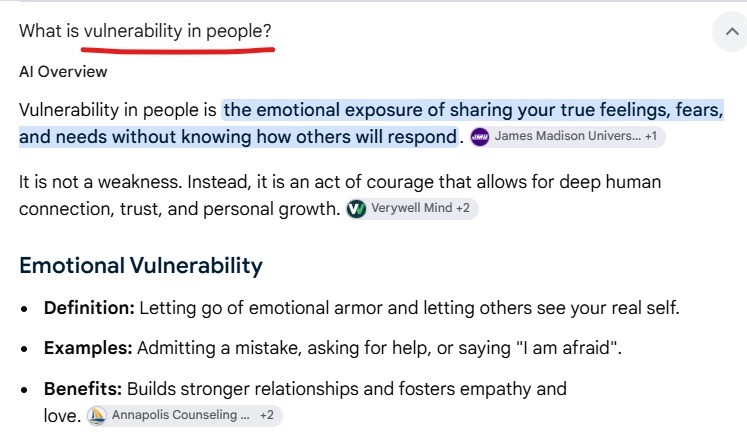
Brené Brown defines vulnerability as “uncertainty, risk, and emotional exposure.” Brown goes on to suggest that vulnerability is our most accurate measure of courage; we allow ourselves to be seen when we are vulnerable. Brené Brown teaches her followers that vulnerability is typically thought of as the center of emotions, such as grief, shame, fear, and disappointment, but it is also the center and birthplace of love, belonging, authenticity, creativity, courage, and accountability.
Selective reinforcement and modeling has been used to help children learn from a young age how to regulate and take accountability for their emotions. Unpleasant emotional states are managed by their subjective discomfort. Emotional vulnerability is also impacted by respondents that express feelings of sadness about the uncertainty of climate change. Increasing awareness and impact leads to heightened emotional responses. In later life, the strength and vulnerability integration (SAVI) model holds that older adults become better at avoiding situations likely to upset them, but worse at coping physiologically when strong emotional arousal cannot be avoided and persists. Along with this, emotional vulnerability can affect the physical well-being of older adults when they suppress their emotions in highly distressing situations. When these vulnerabilities are supported through conversation with an emotionally safe “other,” this vulnerability can lead to resilience and the capacity to support others.
(Source: Wikipedia)