
What happens when a doctor defects to economics and the humanities — and then asks an AI whether doctors are a tad boring? The answers, from both Claude and Google AI, reveal something deeper than professional stereotypes. Claude argues that medical training, by design, rewards convergent thinking — getting the right diagnosis — over the exploratory, question-generating mind that the humanities cultivate. Years spent in a closed intellectual world produce a certain narrowness, though brilliant exceptions like Oliver Sacks and Atul Gawande remind us it is medical culture, not doctors as people, that deserves the critique. Google AI, characteristically, opts for balance: doctors are not boring, merely exhausted. But perhaps the most honest insight lies in the afterthought the questioner himself appends — that his intense dislike of medicine may be colouring his perception of those who stayed. Self-knowledge, as ever, is the beginning of wisdom.
Tag: India
The Entrepreneur — Wealth-Seeker or Dharmic Agent? Why the Bhagavad Gita Sees Business as Sacred Yajna
The popular imagination has long cast the businessman as a necessary evil — someone who accumulates wealth while society grudgingly tolerates him. But this is a profound distortion of the Dharmic vision.
The Bhagavad Gita does not treat any profession as spiritually inferior. What it insists upon is svadharma — the faithful and selfless execution of one’s ordained function in the cosmic order. The entrepreneur’s svadharma is not merely profit; it is artha-srishti, the creation of the material conditions of civilizational life. Without him, no temple gets built, no scholarship gets patronized, no army gets fed.
In Chapter 3, Krishna establishes that all action must be performed in the spirit of yajna — sacrifice. The businessman who creates genuine value, employs livelihoods, and takes risk so others may have security is performing a yajna. His enterprise, when rightly oriented, is a sacrificial act in the cosmic order.
As Kautilya declares in the Arthashastra: Dharmasya mulam arthah — the root of dharma is artha. The society that dishonors its wealth-creators dishonors its own life-force. The Gita asks not that the businessman renounce his activity, but that he transfigure it — from mere acquisition into sacred function.
“If one knows Brahman as non-existent…” — Sankaracharya’s Commentary in Taittiriya Upanishad
In his commentary on the Taittiriya Upanishad (II.vi.1), specifically the verse Asad-brahmeti chet veda… (“If one knows Brahman as non-existent…”), Adi Shankaracharya explains that … More
Pakistan Zindabad. India Zindabad
My younger brother called just now from the US and was reminding me about today’s T20 World Cup match between … More
The Truth about Caste System in India
ChatGPT, is there a correct and authentic historical record on whether Brahmins had exclusive monopoly on education? What kind of … More
ChatGPT on Bhakti Yoga
I asked ChatGPT: Can you talk about one’s love for God or so-called self-realization in the context of the previous … More
Religion, Democracy & Constitution in India
Why Sonam Wangchuk Matters: The Moral Compass of a Nation
Sonam Wangchuk stands as a moral compass in a time when dissent is under siege. In our co-authored piece for The Wire, we argue that his peaceful resistance—anchored in Gandhian ideals and ecological wisdom—embodies the conscience of modern India. Wangchuk’s fasts and climate-focused activism are not acts of rebellion but acts of restoration: of truth, environment, and democracy itself. His story is a mirror to the nation’s soul, reminding us that silence is complicity, and courage is the truest form of love for one’s country.
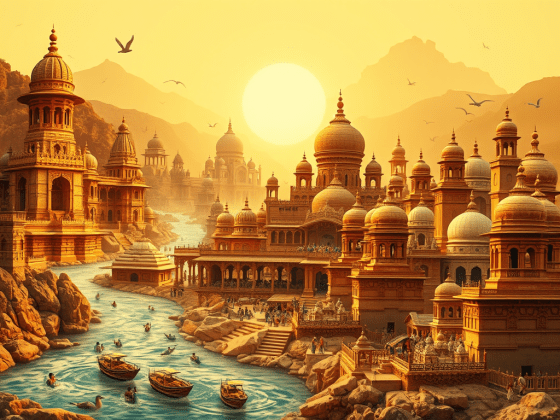
India’s past deserves more than apologia or amnesia
The discourse on Indian history, shaped by Marxist and secular-liberal perspectives, often neglects its civilisational essence, presenting a fragmented narrative. Early thinkers argued for India’s spiritual unity, highlighting shared practices and symbols over political divisions. Modern historians prioritize economic and social factors, missing the broader ethical and cultural dimensions that define Indian civilization.
Why Do We Not Love One Another?
The simple answer to my question in the title is, “Because we live in the mind and not in the … More
 Know Thyself