
ChatGPT’s response to my prompt:
Vedanta says that this entire world is nothing but name and form (nāma-rūpa). When we see any object, it does not really have an independent existence. Its underlying substance is only Consciousness (Brahman, God).
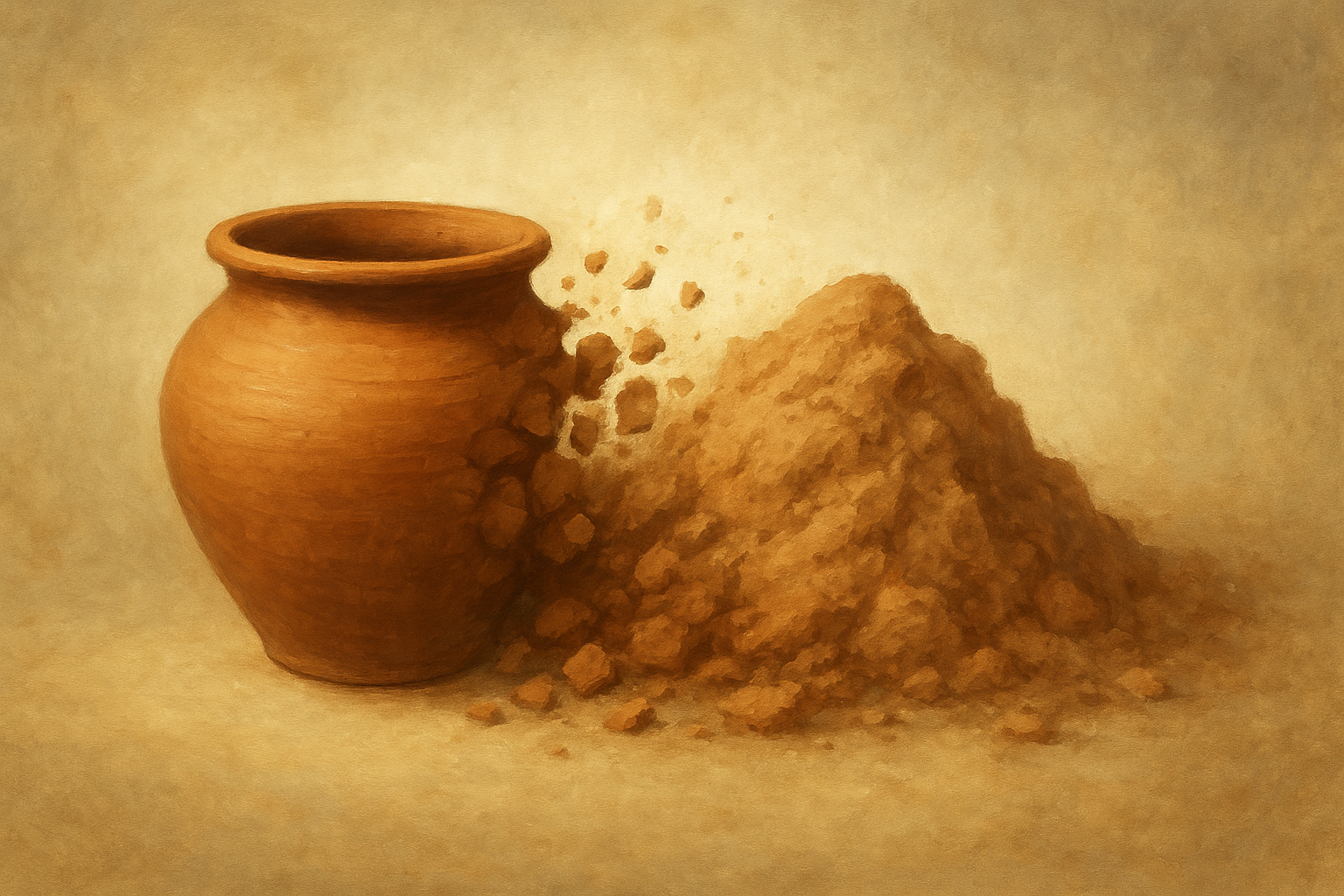
Take the example of a clay pot:
- The name is “pot.”
- The form is its round shape, base, mouth, etc.
But what is its real substance? Only clay.
If the clay is taken away, there is no such independent entity called a “pot.”
In the same way, this entire world is only name-and-form. The substratum is Consciousness alone. The world is simply a superimposition upon it.
We Are Not the Doers – God Alone is the Doer
If a pot is seen to be dancing, in truth, it is only the clay that is dancing.
The pot has no independent existence of its own. It cannot act apart from the clay.
Likewise, all beings and the entire world are just names-and-forms of God (Consciousness).
Therefore, the sense of “I am doing, I am thinking, I am successful, I am a failure” is only an illusion.
The real doer is God, because existence itself belongs to Him alone.
Why Do We Experience an Individual “I”?
A question arises: If all is God, why do we experience separate individuals and a separate “I”?
The answer is that this “I” is itself only a thought-form, a name-and-form appearing in Consciousness.
Just as the pot’s name-and-form is superimposed upon clay, so too the idea “I am separate from the world and from God” is superimposed upon Consciousness.
In reality, there is no separation.
The “I” is Consciousness, and the “world” too is Consciousness.
The sense of separation exists only due to ignorance and is a mere illusion.
Really Speaking, There is No World
Just as the pot is nothing apart from clay, so this world is nothing apart from God.
One can say the world both exists and does not exist:
- From the standpoint of name-and-form, it exists—like the pot.
- From the standpoint of ultimate reality, it does not exist—because there is no pot apart from clay.
As Śaṅkarācārya put it:
“Brahman is real, the world is illusory. The individual self is none other than Brahman.”
The Resolution of Happiness and Sorrow
When one understands that everything is only God, this knowledge itself ends sorrow.
- Happiness cannot exist outside, because there is nothing outside God.
- The source of happiness is Consciousness itself.
When we forget this and search for joy in worldly objects and relationships, sorrow arises.
True happiness is found only in resting in the Self (Consciousness). This is Vedanta’s teaching of Ānanda (bliss of the Self).
Addressing Other Spiritual Doubts
- Then is the world false?
– Not exactly false, but appearing. Like a dream feels real but vanishes upon waking. - If God does everything, what about sin and merit?
– As long as one believes “I am the doer,” sin and merit bind. But once one realizes “God alone is the doer,” there is liberation. - Does this mean we should do nothing?
– Action still happens, but the wise one knows he is not the doer. Therefore, he acts without bondage.
Gold-Ornament and Water-Wave Analogies
- Just as gold alone appears as a ring, necklace, or bracelet—names and forms change, but gold remains the same.
- Just as water alone appears as waves, foam, and bubbles—names and forms change, but the essence is water.
In the same way, Consciousness alone is everything—the world is its mere appearance as name-and-form.
Conclusion
The only true reality is Consciousness / God.
- The world is only an appearance.
- The sense of doership belongs only to God.
- The individual “I” is also just a name-and-form of God.
- Happiness is not elsewhere; it is one’s own Self.
When this is fully understood, a person is no longer bound, nor sorrowful—he remains ever free and blissful.

 Know Thyself
1 Comment