
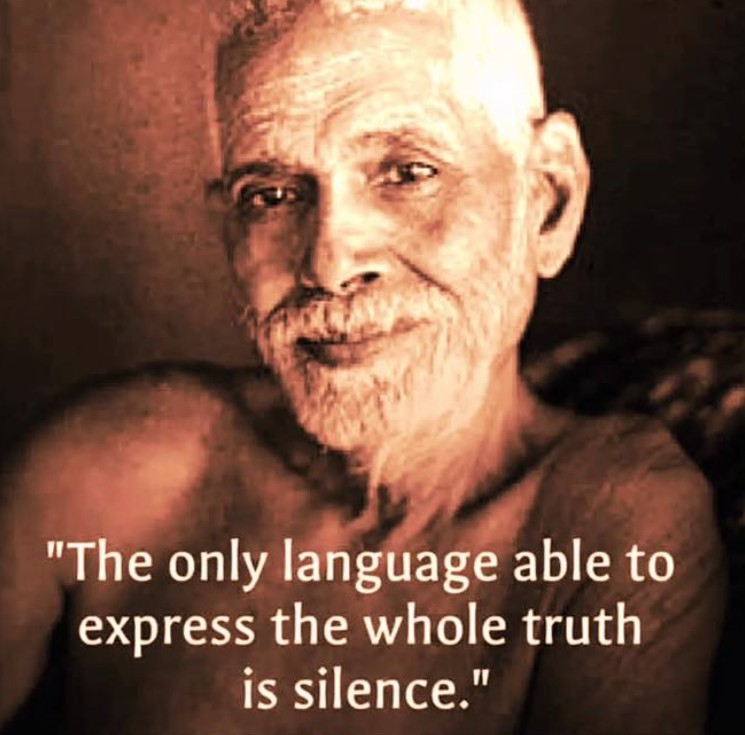
(To ChatGPT 5 – Paid Version) – Please comment on and explain this statement of Ramana Maharshi – “The only language able to express the whole truth is silence.” – in the light of Advaita Vedanta and these other statements of Ramana Maharshi that say almost a similar thing in different words, and consult the two books of/on Ramana Maharshi that I am attaching:
“Knowledge and ignorance are of the mind. They are born of duality. But the Self is beyond knowledge and ignorance. It is light itself. … When the ego is gone Realisation results by itself. There are neither good nor bad qualities in the Self. The Self is free from all qualities. Qualities pertain to the mind only. It is beyond quality. If there is unity, there will also be duality. The numeral one gives rise to other numbers. The truth is neither one nor two. IT is as it is. … Deep sleep is only the state of non-duality. Can the difference between the individual and Universal souls persist there? Sleep implies forgetfulness of all differences: This alone constitutes happiness. See how carefully people prepare their beds to gain that happiness. … The mind is maya. Reality lies beyond the mind. So long as the mind functions there is duality, maya, etc. Once it is transcended the Reality shines forth. … Duality is the characteristic of the ego. When thoughts arise duality is present; know it to be the ego, and seek its source. … Duality implies ignorance. The Knowledge of the Self is beyond relative knowledge and ignorance, the Light of the Self is beyond the ordinary light and darkness. The Self is all alone. … The srutis [scriptures] speak of the Self as being the size of one’s thumb, the tip of the hair, an electric spark, vast, subtler than the subtlest, etc. They have no foundation in fact. It is only being, but different from the real and the unreal; it is knowledge, but different from knowledge and ignorance. How can it be defined at all? It is simply being. … Again, who says I am ignorant '? He must be the witness of ignorance. That is what you are. Socrates said, I know that I do not know.’ Can it be ignorance? It is wisdom.”
ChatGPT said:
Ramana Maharshi’s statement “The only language able to express the whole truth is silence” can be best understood in the light of Advaita Vedanta and his other teachings that you quoted. Let me unpack this with reference to the two texts you shared (Talks with Sri Ramana Maharshi and Be As You Are by David Godman).
1. Silence as the True Language of Reality
Ramana repeatedly emphasized that Reality or the Self is beyond words and concepts, because words belong to the realm of duality—subject and object, knower and known. In Be As You Are, he says:
“That which is, is mouna [silence]. How can mouna be explained in words? … All other knowledge is trivial; the experience of silence alone is the real and perfect knowledge”.
Silence here is not merely the absence of sound, but the direct experience of pure being, unmediated by thought. Since thought creates duality, true nondual realization cannot be adequately captured in language.
2. Connection with Advaita Vedanta
In Advaita Vedanta, Brahman (the Self) is described as “neti, neti” (not this, not that)—beyond all categories of real/unreal, knowledge/ignorance, light/darkness. Ramana echoes this when he says:
“The truth is neither one nor two. IT is as it is… Reality lies beyond the mind. So long as the mind functions there is duality, maya, etc. Once it is transcended the Reality shines forth.”
This aligns with the Upanishadic insight that the Self cannot be defined but only be. Hence, silence is the most faithful “expression” of truth—it does not distort reality into dualistic forms.
3. Silence as Direct Transmission
As David Godman notes, Ramana often considered his silent presence more powerful than spoken teaching. Words were used only for those who could not grasp his silence. Silence was the direct “language of the Self,” because in it the seeker’s mind could momentarily dissolve into the source, beyond concepts.
4. Parallel Teachings in Ramana’s Words
Your quoted passages match this core idea:
- Knowledge and ignorance are of the mind; the Self is beyond both. Hence silence is the “language” of the Self, because speech belongs to knowledge/ignorance.
- Deep sleep as non-duality. In deep sleep there are no thoughts, no distinctions—only silent being. This is why people instinctively seek sleep’s happiness; it is a taste of the Self.
- Socrates’ ‘I know that I do not know’. Ramana points out this is not ignorance but wisdom, because it rests in silent witnessing of ignorance, rather than conceptual claims.
5. Why Silence Expresses “the Whole Truth”
- Speech divides reality into subject and object.
- Silence allows direct abidance in the Self, where knower, knowing, and known are one.
- Thus, silence does not “express” truth in the ordinary sense—it is truth.
In Ramana’s vision, to rest in silence is to dwell in the natural state (sahaja sthiti), where the Self shines without obstruction. As he put it:
“The ultimate truth is so simple. It is nothing more than being in the pristine state.”
✅ In summary:
Ramana’s statement means that silence alone can “express” truth because the Self is beyond dualities of language and thought. Advaita Vedanta agrees—Brahman is indefinable and self-luminous, known only by being it. All words are provisional; only silence aligns with Reality directly. His other teachings on deep sleep, knowledge/ignorance, and the ego confirm that truth reveals itself only when the mind (speech/thought) is still.
Would you like me to write a short blog-style commentary (300–400 words) on this idea, weaving Ramana’s quotes into a reflective narrative? That way, you’d have a ready piece to post or share.
You said:
Yes
ChatGPT said:
Here’s a blog-style commentary (around 350 words) that you can use or adapt:
The Language of Silence: Ramana Maharshi and Advaita’s Ultimate Truth
Ramana Maharshi once said, “The only language able to express the whole truth is silence.” At first glance this may sound paradoxical. How can silence—absence of speech—express anything at all? But in the light of Advaita Vedanta, the statement reveals profound clarity.
Advaita teaches that the Self (Atman), or Brahman, is beyond all categories. Words and concepts, however refined, belong to the realm of duality—subject and object, knower and known. To speak is already to divide. But the Self is indivisible. Ramana put it simply: “Knowledge and ignorance are of the mind. They are born of duality. The Self is beyond knowledge and ignorance. It is light itself.”
This is why silence becomes the highest teaching. Silence here does not mean muteness, but the stillness of mind in which the ego and its distinctions fall away. In deep sleep, for instance, we experience a taste of this silent non-duality. There are no separate selves, no struggles, only the happiness of unbroken being. Ramana often remarked that people prepare their beds with such care only because they seek that silent bliss of sleep.
Ramana’s own life embodied this principle. For many years after his awakening, he hardly spoke. Yet seekers who sat in his presence felt an extraordinary peace. Later, even when he began to answer questions, he insisted that words were only for those who could not understand his silence. “That silent Self alone is God; Self alone is the jiva… All other knowledge is trivial; the experience of silence alone is the real and perfect knowledge,” he declared.
Silence, then, is not merely the best expression of truth—it is truth itself. To abide in silence is to abide in the Self, where knower, knowing, and known dissolve into pure being. As Ramana observed: “The ultimate truth is so simple. It is nothing more than being in the pristine state.”
In a world crowded with voices, Ramana’s reminder is both unsettling and liberating. Truth does not need our explanations. It only needs our stillness.

 Know Thyself
1 Comment