
A friend shared the following: Source: The Marginalianhttps://share.google/aF6gajROev0gJ8Uzd I replied: The soul is distinct from the Self. Self is the … More
Tag: Nonduality
Uniworse
Uniworse. Claude, comment. Claude: Calibrated wit with philosophical depth for playful engagement “Uniworse” — the universe as experienced on a … More
My Final Hurrah!
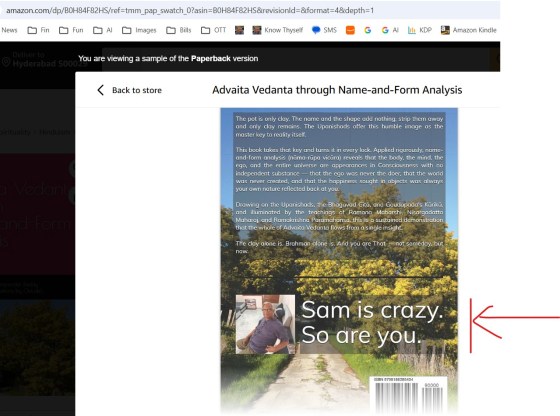
Just published on Amazon my 20th book (I hope this will be my last book) “Summa Iru: My Formal Renunciation … More
Summa Iru: On Desire, Ignorance, and the Vicious Cycle That Isn’t — What I Wrote to My Kalyana Mitra and Claude’s Critique of It
What is Vedanta’s final instruction, once the four yogas, the scriptures, and the practices are stripped away? Summa iru — be still. But if stillness is the goal, why does the mind refuse it? This letter traces a four-link chain — ignorance, desire, thought, action — to argue that the “obstacles” of Buddhist Abhidharma’s kleshas are symptoms of desire, and desire itself is a symptom of the deeper ignorance that we are body-mind alone. A companion critique examines the circularity this seems to create, and asks whether stillness must be achieved through effort, or simply uncovered by inquiry.
Summa Iru: Formal Renunciation for The Dissolution of the False Self
All my life I have been ending ignorance — reading, thinking, writing, seeking. Now the loose ends are nearly tied. Come July 16, my 62nd birthday, it will be summa iru: not a thing I choose, but what happens when the false self, strung together from my relationships, finally dissolves. The more I carve out this “Me Time,” the more I begin to disappear. Nothing defines me; nothing tells me who I am. And so the old question arises almost naturally — “Who am I?” — a question one can sit with, alone, and stand a very good chance of answering.
My Latest Book Available Now on Amazon — The Mind Itself Is a Digression: Poems, Reflections, and Dialogues of a Restless Seeker
Kindle eBook In India: https://www.amazon.in/dp/B0H4X9NFMB In USA: https://www.amazon.com/dp/B0H4X9NFMB Paperback In USA: https://www.amazon.com/dp/B0H58FG4VK The mind itself is a digression — or … More
“Is it perfume from a dress / That makes me so digress?”
No, Eliot, it is not the perfumeFrom a dress or otherwiseThat makes me digress. I digressBecause the mind itself is … More
The Distance
Love is what makes the world go aroundSo it is said; I do not differYet I differ in a wayI … More
I Am Not A Thought – So Who Am I Really? – Nisargadatta Maharaj Wisdom
Giving Myself Carte Blanche
What does it mean to give oneself carte blanche without becoming irresponsible? In this reflective piece, I explore a deeply personal decision: to spend most of the day in deliberate solitude. Not as withdrawal. Not as rebellion. But as a conscious turning inward.
Rooted in the wisdom of Nisargadatta Maharaj, this practice centers on abiding in the simple yet profound sense of “I am.” Beyond roles, beyond relationships, beyond achievements—what remains when one rests in bare awareness?
This inward freedom does not violate the moral boundary articulated by Justice Oliver Wendell Holmes Jr.: “The right to swing my fist ends where the other man’s nose begins.” Instead, it is an experiment in inner sovereignty—an attempt to discover whether sustained attention to the “I am” can transform not only solitude, but relationship, responsibility, and presence itself.
Is solitude an escape, or the highest form of engagement with truth?

