
In my going summa iru lieA few positive externalitiesYou will start to realizeBeing alone holds no terrorsYou will start to … More
Category: Nonduality (Advaita)
“You need to empty yourself, even of God, to find God.”
“You need to empty yourself, even of God, to find God.”–Eckhart The Philosophy of Emptiness – The Most Dangerous Teaching … More
“But Why Wait for Your Birthday?” — A Friend Presses Further on Summa Iru
The friend who asked me the question “Is your summa iru resolve like a new year resolution?” (https://selfrealization.blog/2026/07/11/is-your-summa-iru-resolve-like-a-new-year-resolution/) responded to … More
“Is your summa iru resolve like a new year resolution?”
A friend asked: Do you naturally feel like doing it [summa iru]? Are you personally convinced that you should drop … More
Love & the Shadow of Truth
Claude, comment on this saying of mine: “The shadow of Truth falls on everything and everyone I love in my … More
Soul and The Drama of This World
A friend shared the following: Source: The Marginalianhttps://share.google/aF6gajROev0gJ8Uzd I replied: The soul is distinct from the Self. Self is the … More
My Final Hurrah!
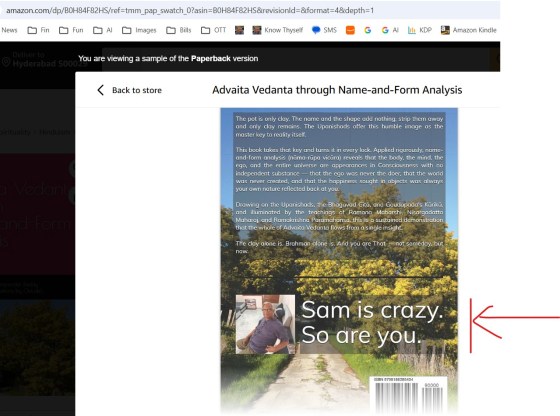
Just published on Amazon my 20th book (I hope this will be my last book) “Summa Iru: My Formal Renunciation … More
The Courage To Be Myself
I care NOT to be anythingNo, not even BrahmanThough I’m told I’m already thatWho put me on earthWho made me … More
Quit
“Life is not a battle worth fighting. Quit.” The word is a deliberate stumbling block. What is to be given up is not the body or the life, but the fighter — the ego whose founding myth is that life is a war to be won. Camus answered the question of life’s worth with revolt; Advaita takes the path he never considered: neither suicide nor defiance, but the dissolution of the one who asks. Quit the way a fist quits clenching. The battle is optional because the soldier is fictional. What remains is life itself — neither fought nor fled.
When Feelings Turn into Strangers: Purity, Compassion, and the Loosening of Worldly Bonds
In isolation, even once-intense emotions can begin to feel like strangers seeking attention — a sign, if genuine, that one’s bonds with the world are loosening. But this loosening is not an end in itself: its authenticity is tested by what remains. Where being is pure, feelings coalesce into compassion alone; where the ego persists, they remain self-serving, whatever else they resemble. Drawing on the Bhagavad Gita’s vision of the sage who sees a Brahmin, a cow, and an outcaste with equal eyes, this piece explores why true compassion is never particular — and how to tell purity apart from mere numbness.

