
Does human love — the love one person feels for another, sometimes unreturned — help or hinder liberation? This dialogue begins there and refuses the usual escape routes: no sublimating the beloved into the Beloved, no dissolving the particular person into metaphysics. It stays with the scandalously particular: this laugh, this handwriting, this way of falling silent mid-sentence. Along the way it separates the two strands entangled in every love — the ego-dismantling that cracks our solipsism, and the pleasure-seeking that certifies our lack — and examines the precise mechanics by which seeking rains on the parade to liberation: the misattributed ananda, the rented ego-death of sex, the anxiety of separateness managed rather than investigated. Krishnamurti’s “understanding is the action” and Ramana’s summa iru frame the inquiry, but the conversation turns its own weapon on itself at the end: isn’t liberation-seeking the final quarrel with the present? Why flee the human that Brahman itself created? Zorba the Greek enters, dancing on the beach after the mine collapses — and the dialogue discovers that the end-state looks embarrassingly like ordinary life fully inhabited, with one difference: no proprietor left behind experience, filing claims against it.
Tag: Nietzsche
“They are no philosophical race”: Nietzsche’s Critique of the Englishman’s Philosophy
Nietzsche reserved special contempt for the English philosophical tradition, seeing in its utilitarianism and empiricism a triumph of mediocrity over greatness. “Man does not strive for happiness; only the Englishman does,” he declared — skewering Bentham and Mill’s reduction of morality to mere comfort and calculation. For Nietzsche, British moral philosophy was herd morality dressed in academic clothing: it flattened human hierarchy, punished excellence, and mistook survival for nobility. Even Darwin’s legacy, filtered through Spencer, pointed downward toward the average. The English, he charged, were industrious but philosophically shallow — incapable of the dangerous, self-overcoming thought true philosophy demands.
Nietzsche’s Pathos of Distance
The pathos of distance (Pathos der Distanz) is one of Nietzsche’s most revealing sociological and psychological concepts, introduced most prominently … More
Zorba the Greek: A Philosophy of Living
Nikos Kazantzakis’s Zorba the Greek stands as one of the most vivid explorations of the tension between intellectual contemplation and … More
Shut up, Nietzsche
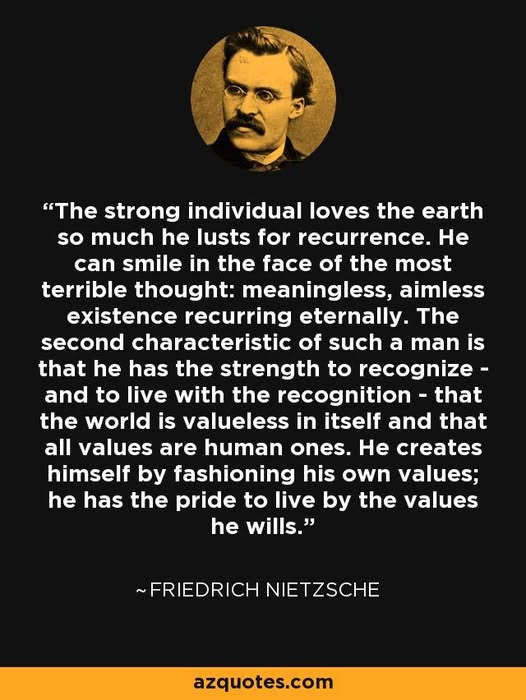
“Shut up, Nietzsche, I have no more interest left in this world, except maybe to complain about how meaningless and … More

Question the Answer, Question the Question – To My Dear Friend Pramod Reddy
Chum, you seem to have spent Some of your youth In the company of Nietzsche How else can I account … More
Far right, misogynist, humourless? Why Nietzsche is misunderstood
from The Guardian: Friedrich Nietzsche, Karl Marx and Charles Darwin are the great triumvirate of 19th-century thinkers whose ideas still … More
Where the Stoics go wrong, and how Nietzsche gets it right
“If Stoic wisdom helps you to live the way you want to, then go for it. But if, like me, … More

