
No, Eliot, it is not the perfumeFrom a dress or otherwiseThat makes me digress. I digressBecause the mind itself is … More
Tag: Upanishads
Beyond the Golden Veil: Transcending Sattva, Para Vidya, and the Final Frontier of Self-Knowledge in Advaita
Of the three gunas that constitute all of manifest existence, Sattva — the quality of luminosity, harmony, and knowledge — is the most seductive bondage. Unlike Tamas, which crushes, or Rajas, which burns, Sattva seduces with bliss, ethical refinement, and the pleasures of understanding. Ramakrishna’s parable of the three robbers captures this with surgical precision: the sattvic robber alone unties the traveller and shows him the path home — but does not take him there. The finest veil is still a veil.
The Mundaka Upanishad’s distinction between Apara Vidya — all systematized human knowledge, from the sciences to the humanities — and Para Vidya, the knowledge by which the Imperishable is realized, frames this predicament with extraordinary clarity. No accumulation of apara vidya, however refined and sattvic, can answer the question the Upanishad’s Shaunaka poses at the outset: by knowing what does everything become known? That question dissolves the knower, and no object of knowledge can accomplish that.
Ramana Maharshi, Nisargadatta Maharaj, and J. Krishnamurti — approaching from different angles — converge on a single insight: the final obstacle to liberation is not ignorance or desire, but the subtle, luminous, deeply respectable self that knows.
The Bhagavad Gita Explained: Key Teachings and Insights
The Bhagavad Gita — spoken on a battlefield over two thousand years ago — remains one of the most profound guides to the human condition ever written. Yet its philosophical depth, Sanskrit terminology, and eighteen dense chapters can feel overwhelming to modern readers.
Sammary of the Bhagavad Gita by D. Samarender Reddy is not a translation or a conventional commentary. It is a guided philosophical journey through the Gita’s core teachings — written for the intelligent general reader who wants to genuinely understand what the Gita is saying, why it says it, and what difference it makes to how one lives.
The book covers the Gita’s two-tier vision of Reality, the Goal of Life as Krishna defines it (compared with Buddhism, Christianity, Stoicism, and modern psychology), the four paths of Karma Yoga, Jñāna Yoga, Bhakti Yoga, and Raja Yoga, and practical guidance on action, duty, meditation, and liberation. A complete fresh English translation of all eighteen chapters is included as an appendix.
Whether you are encountering the Gita for the first time or returning after years of study, this book will deepen your understanding of why this ancient dialogue continues to speak — with remarkable directness — to the most urgent questions of human life.
Desires to Desirelessness – Vedas (Karmakand) Vs. Upanishads (Jnanakand)
What has morality taught you? Desire is evil, but that’s not so in the case of the Rigveda. Here you … More
I Have Paid My Dues to This World
I feel like I have paid my dues to this world. How so? Firstly, I have fulfilled my duty towards myself … More
Why the Knower Cannot Be “Known”: Advaita Vedanta and the Hard Problem of Consciousness
The Bṛhadāraṇyaka Upaniṣad asks, “By what can one know the Knower?” Modern neuroscience and philosophy of mind echo the same puzzle in the “hard problem of consciousness.” Instruments and theories can track brain states and behavior, but never Awareness itself—the very light by which all knowing occurs. Advaita Vedānta makes the radical move: the Knower is not an object of study but the Self, svayam-prakāśa, self-luminous. To seek it as an object is like the eye trying to see itself. Liberation lies in abiding as That, not in endless inquiry.
Para Vidya (Higher Learning) Vs. Apara Vidya (Lower Learning)
The Mundaka Upanishad divides knowledge into two streams. Apara Vidya embraces all sciences and arts—the brilliance of mathematics, the sweep of history, the beauty of literature and philosophy. These disciplines teach us about the world of names and forms, yet remain within the realm of duality. Para Vidya, by contrast, points only to the essence—Brahman, Consciousness, the clay beneath all pots. The first refines the intellect, the second liberates the self. To honor both is wisdom: to study the many with care, and to seek the One with devotion.
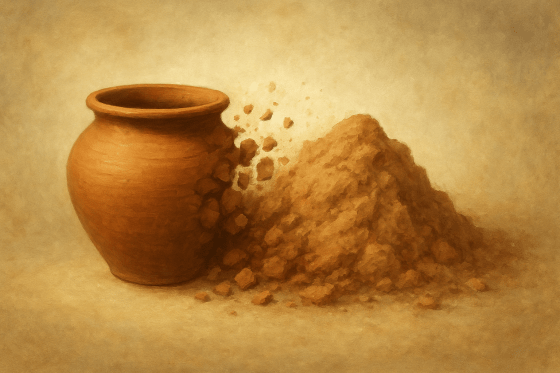
The Vedantic Concept of Name-and-Form
Vedanta teaches that the world is nothing but name-and-form, with Consciousness as its sole reality. Just as a pot is only clay appearing in a certain form, this universe is only God appearing as countless names and forms. The sense of an individual “I” too is merely a thought-form within Consciousness. When this truth is realized, doership dissolves, sorrow ends, and one discovers that true happiness lies not outside but in the Self, which is ever free, blissful, and divine.
From Metaphysical Weariness to Self-Realization
There are moments in life when fatigue runs deeper than the body or mind—it’s a weariness of existence itself. Not depression, not despair, but a quiet recognition that life as we know it may be part of a grander cosmic play. In this exchange, I explore this metaphysical tiredness through the lens of Advaita Vedanta and the teachings of Ramana Maharshi, Nisargadatta Maharaj, and J. Krishnamurti. What emerges is a simple yet profound daily contemplative routine—an invitation to step beyond egoic striving and rest in pure Awareness, where true happiness and freedom reside.
Swami Paramarthananda’s Commentaries – Books and Videos
In addition to the books for free download, it has all his video talks on the various Upanishads and Gita.
 Know Thyself