
Claude, comment on the line “ab tak to jo bhi dost mile, bewafa mile” from the song https://www.youtube.com/watch?v=7I4nSYHL-cQ in the … More
Tag: Vairagya
Quit
“Life is not a battle worth fighting. Quit.” The word is a deliberate stumbling block. What is to be given up is not the body or the life, but the fighter — the ego whose founding myth is that life is a war to be won. Camus answered the question of life’s worth with revolt; Advaita takes the path he never considered: neither suicide nor defiance, but the dissolution of the one who asks. Quit the way a fist quits clenching. The battle is optional because the soldier is fictional. What remains is life itself — neither fought nor fled.
“What are we here on earth for?”
Much as I love her, yes I do, Much as she does not love me Though she cares for me, … More
When Feelings Turn into Strangers: Purity, Compassion, and the Loosening of Worldly Bonds
In isolation, even once-intense emotions can begin to feel like strangers seeking attention — a sign, if genuine, that one’s bonds with the world are loosening. But this loosening is not an end in itself: its authenticity is tested by what remains. Where being is pure, feelings coalesce into compassion alone; where the ego persists, they remain self-serving, whatever else they resemble. Drawing on the Bhagavad Gita’s vision of the sage who sees a Brahmin, a cow, and an outcaste with equal eyes, this piece explores why true compassion is never particular — and how to tell purity apart from mere numbness.
Beyond the Golden Veil: Transcending Sattva, Para Vidya, and the Final Frontier of Self-Knowledge in Advaita
Of the three gunas that constitute all of manifest existence, Sattva — the quality of luminosity, harmony, and knowledge — is the most seductive bondage. Unlike Tamas, which crushes, or Rajas, which burns, Sattva seduces with bliss, ethical refinement, and the pleasures of understanding. Ramakrishna’s parable of the three robbers captures this with surgical precision: the sattvic robber alone unties the traveller and shows him the path home — but does not take him there. The finest veil is still a veil.
The Mundaka Upanishad’s distinction between Apara Vidya — all systematized human knowledge, from the sciences to the humanities — and Para Vidya, the knowledge by which the Imperishable is realized, frames this predicament with extraordinary clarity. No accumulation of apara vidya, however refined and sattvic, can answer the question the Upanishad’s Shaunaka poses at the outset: by knowing what does everything become known? That question dissolves the knower, and no object of knowledge can accomplish that.
Ramana Maharshi, Nisargadatta Maharaj, and J. Krishnamurti — approaching from different angles — converge on a single insight: the final obstacle to liberation is not ignorance or desire, but the subtle, luminous, deeply respectable self that knows.
Nee illu Ekkado Telusa – “నీ ఇల్లు ఎక్కడో తెలుసా” || Telugu Folk Song
“నీ ఇల్లు ఎక్కడో తెలుసా?” — Do you know where your true home is? This powerful Telugu folk song cuts through life’s illusions with fearless honesty, addressing the restless human mind directly. You celebrate your house, your family, your wealth — but your real final home, the song reminds us, lies at the cremation ground. You arrived in this world with nothing, and you will leave with nothing.
The song urges the mind not to cling to spouse, children, or siblings — for on the day you depart, even your closest loved ones will hesitate to come near. It questions the endless wrestling over property and possessions, calling them asthi ramu — unstable, impermanent. Fame and status fare no better: “How significant are you in this vast universe? How far does your name really reach?”
Even the body you call your own will one day abandon you. Belonging to the Telugu Vairagya tradition of philosophical folk poetry — echoing saints like Vemana and Kabir — this song does not preach despair. It preaches awakening. Surrender to the eternal, unseen divine, it says, for in a life of total impermanence, that alone is real.
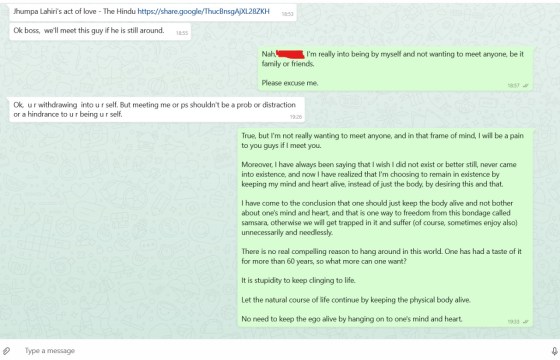
Why Keep the Ego Alive By Hanging on to the Mind & Heart
Whither Freedom?
“As long as you want to use the body-mind given you for your own purposes such as fulfilling your own … More

