
“No Time…No Space…No Mind…No We. Where are ALL these things, including also God, when we are silent? Not there. Only … More
Category: Indian Philosophy
The Final Exit?
Have I something to give to this world in the form of my “understanding” of Advaita Vedanta? Haven’t I already … More
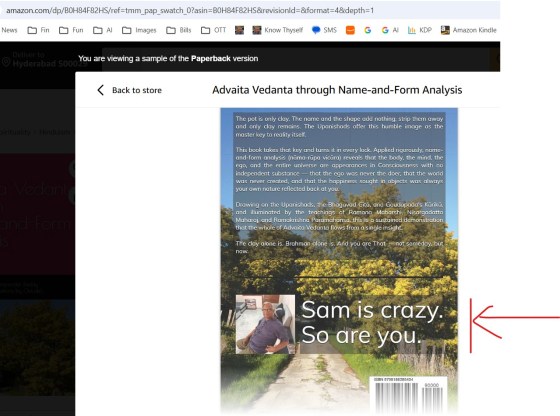
My Final Hurrah!
Just published on Amazon my 20th book (I hope this will be my last book) “Summa Iru: My Formal Renunciation … More
Don’t Worry About the Future — It is Already Fixed
Here is the email I wrote to my younger sister Kavitha just now, who is travelling with her family in … More
The 2nd Verse of Ashtavakra Gita
The 2nd verse of Ashtavakra Gita is this reply by Ashtavakra: “If you are seeking liberation, my son, avoid the … More
Indians Have Stopped Thinking
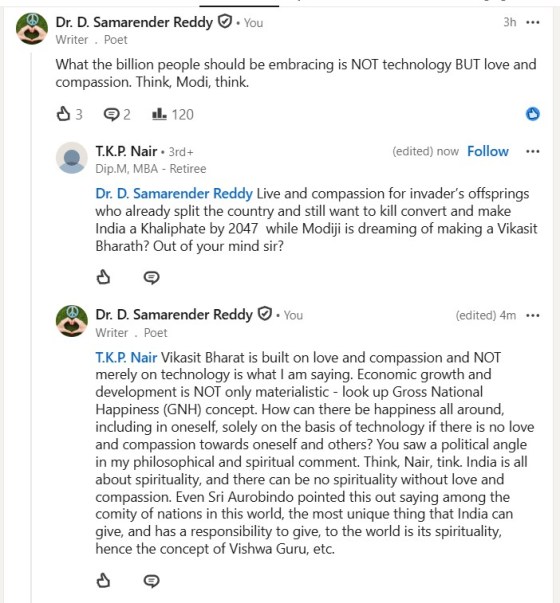
In reply to this comment of mine https://selfrealization.blog/2026/07/01/the-message-i-gave-to-the-indian-pm-modi-on-linkedin-but-he-will-not-listen-no-one-listens/ someone replied: “Love and compassion for invader’s offsprings who already split the … More
Summa Iru: Formal Renunciation for The Dissolution of the False Self
All my life I have been ending ignorance — reading, thinking, writing, seeking. Now the loose ends are nearly tied. Come July 16, my 62nd birthday, it will be summa iru: not a thing I choose, but what happens when the false self, strung together from my relationships, finally dissolves. The more I carve out this “Me Time,” the more I begin to disappear. Nothing defines me; nothing tells me who I am. And so the old question arises almost naturally — “Who am I?” — a question one can sit with, alone, and stand a very good chance of answering.
My Latest Book Available Now on Amazon — The Mind Itself Is a Digression: Poems, Reflections, and Dialogues of a Restless Seeker
Kindle eBook In India: https://www.amazon.in/dp/B0H4X9NFMB In USA: https://www.amazon.com/dp/B0H4X9NFMB Paperback In USA: https://www.amazon.com/dp/B0H58FG4VK The mind itself is a digression — or … More
Mind is the Prison. Walk Out
You are already enlightened but you are thinking you are not — the pot is already is and always was … More
One More Look at the Caste System
“You are what your deep, driving desire is. As your desire is, so is your will. As your will is, … More

