
Does human love — the love one person feels for another, sometimes unreturned — help or hinder liberation? This dialogue begins there and refuses the usual escape routes: no sublimating the beloved into the Beloved, no dissolving the particular person into metaphysics. It stays with the scandalously particular: this laugh, this handwriting, this way of falling silent mid-sentence. Along the way it separates the two strands entangled in every love — the ego-dismantling that cracks our solipsism, and the pleasure-seeking that certifies our lack — and examines the precise mechanics by which seeking rains on the parade to liberation: the misattributed ananda, the rented ego-death of sex, the anxiety of separateness managed rather than investigated. Krishnamurti’s “understanding is the action” and Ramana’s summa iru frame the inquiry, but the conversation turns its own weapon on itself at the end: isn’t liberation-seeking the final quarrel with the present? Why flee the human that Brahman itself created? Zorba the Greek enters, dancing on the beach after the mine collapses — and the dialogue discovers that the end-state looks embarrassingly like ordinary life fully inhabited, with one difference: no proprietor left behind experience, filing claims against it.
Tag: Summa iru
My Final Hurrah!
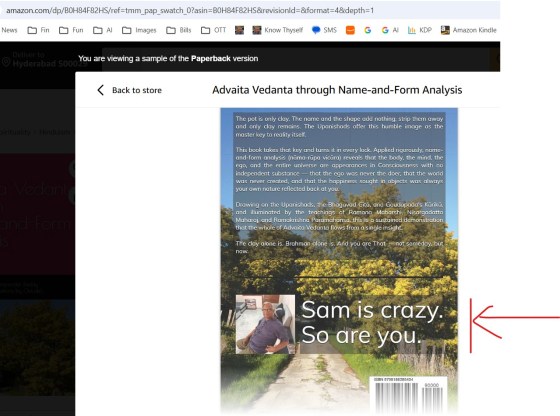
Just published on Amazon my 20th book (I hope this will be my last book) “Summa Iru: My Formal Renunciation … More
On the Stillness of the Mind — by J. Krishnamurti
“The mind is quiet when it sees the truth that understanding comes only when it is quiet…When I see the … More
The Courage To Be Myself
I care NOT to be anythingNo, not even BrahmanThough I’m told I’m already thatWho put me on earthWho made me … More
Quit
“Life is not a battle worth fighting. Quit.” The word is a deliberate stumbling block. What is to be given up is not the body or the life, but the fighter — the ego whose founding myth is that life is a war to be won. Camus answered the question of life’s worth with revolt; Advaita takes the path he never considered: neither suicide nor defiance, but the dissolution of the one who asks. Quit the way a fist quits clenching. The battle is optional because the soldier is fictional. What remains is life itself — neither fought nor fled.
Summa Iru: On Desire, Ignorance, and the Vicious Cycle That Isn’t — What I Wrote to My Kalyana Mitra and Claude’s Critique of It
What is Vedanta’s final instruction, once the four yogas, the scriptures, and the practices are stripped away? Summa iru — be still. But if stillness is the goal, why does the mind refuse it? This letter traces a four-link chain — ignorance, desire, thought, action — to argue that the “obstacles” of Buddhist Abhidharma’s kleshas are symptoms of desire, and desire itself is a symptom of the deeper ignorance that we are body-mind alone. A companion critique examines the circularity this seems to create, and asks whether stillness must be achieved through effort, or simply uncovered by inquiry.
Summa Iru: Formal Renunciation for The Dissolution of the False Self
All my life I have been ending ignorance — reading, thinking, writing, seeking. Now the loose ends are nearly tied. Come July 16, my 62nd birthday, it will be summa iru: not a thing I choose, but what happens when the false self, strung together from my relationships, finally dissolves. The more I carve out this “Me Time,” the more I begin to disappear. Nothing defines me; nothing tells me who I am. And so the old question arises almost naturally — “Who am I?” — a question one can sit with, alone, and stand a very good chance of answering.
Summa Iru — The Pristine Spiritual Path
A friend messaged me, “I have a long way to go”, referring to her ongoing spiritual journey. I replied: How … More
The Million Dollar Question
The question I am asking myself is this: Do I really need to keep thinking, writing, posting, discussing, debating, mulling, … More

