
“Love is one way to conquer lust. Actually, love is a good and pleasant way to conquer many evils in … More
Category: Political Philosophy
When Feelings Turn into Strangers: Purity, Compassion, and the Loosening of Worldly Bonds
In isolation, even once-intense emotions can begin to feel like strangers seeking attention — a sign, if genuine, that one’s bonds with the world are loosening. But this loosening is not an end in itself: its authenticity is tested by what remains. Where being is pure, feelings coalesce into compassion alone; where the ego persists, they remain self-serving, whatever else they resemble. Drawing on the Bhagavad Gita’s vision of the sage who sees a Brahmin, a cow, and an outcaste with equal eyes, this piece explores why true compassion is never particular — and how to tell purity apart from mere numbness.
Don’t Worry About the Future — It is Already Fixed
Here is the email I wrote to my younger sister Kavitha just now, who is travelling with her family in … More
The Divided Self
“We tend to compartmentalize our self. Like for instance, we try to be the tough-minded boss at work, and the … More
Indians Have Stopped Thinking
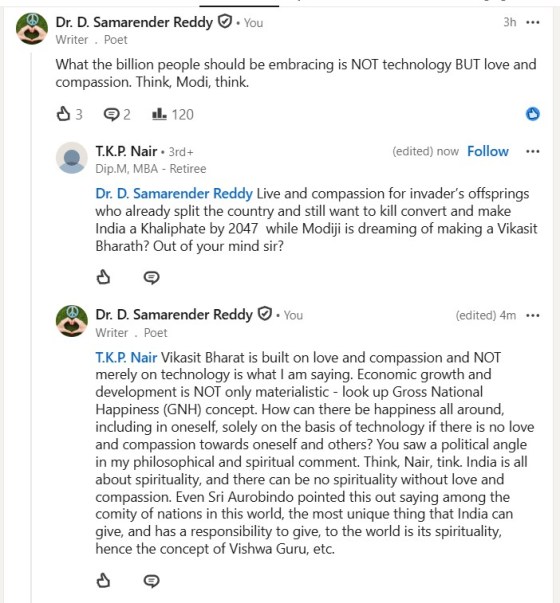
In reply to this comment of mine https://selfrealization.blog/2026/07/01/the-message-i-gave-to-the-indian-pm-modi-on-linkedin-but-he-will-not-listen-no-one-listens/ someone replied: “Love and compassion for invader’s offsprings who already split the … More
Salvation
“In sacrificing your own salvation for the sake of another, you will attain salvation more quickly.”
The Message I Gave to the Indian PM Modi on LinkedIn, But He Will NOT Listen…No One Listens
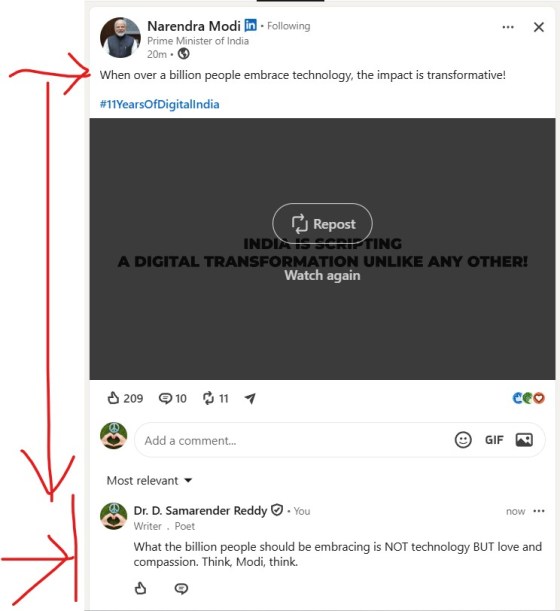
Because everyone is caught up in the materialistic dream/delusion…
I’m Happy Being Bipolar
I’m happy being bipolar But I am not sure others are I drive them crazy with my moods And I … More
The So-called Problems
“Do not try to solve your problems. They are NOT your problems. They are the problems of the body-mind. And … More
Wanna Stop Writing After This
“For a long time now, the role of the Brahmin has been outsourced to other countries, particularly Europe and the … More

