
J. Krishnamurti’s answer to the ancient Hindu aspiration for moksha — liberation from the endless cycle of birth and death — is as radical as it is simple: the very self that seeks liberation is the obstacle. For Krishnamurti, the samsaric wheel turns not because we lack the right method or guru, but because thought, operating as time, continuously reconstructs the “me” — the psychological self built from memory, fear, and desire. Every spiritual practice, every path, every system only strengthens the seeker, and the seeker is precisely what must end. Liberation, he insists, is not a future achievement but a present perception — the choiceless awareness of “what is,” without the observer coloring it. When the self falls silent, what remains is not emptiness but something impersonal: intelligence, love, the sacred. This insight echoes across traditions — in Advaita’s witness-consciousness, Zen’s pathless seeing, Eckhart’s Abgeschiedenheit, and Taoism’s wu wei. The traveler was always the only obstacle. There was never a path because there was never anywhere to go.
Category: Self-realization / Liberation
Summa Iru — The Pristine Spiritual Path
A friend messaged me, “I have a long way to go”, referring to her ongoing spiritual journey. I replied: How … More
Chastity — A Conversation with J. Krishnamurti
“Another thing is that, before our marriage, we vowed never to have any sexual relationship with each other.” Again, why? … More
God’s Fault
“One cannot realize God if one has even the least trace of desire. A thread cannot pass through the eye … More
“Is it perfume from a dress / That makes me so digress?”
No, Eliot, it is not the perfumeFrom a dress or otherwiseThat makes me digress. I digressBecause the mind itself is … More
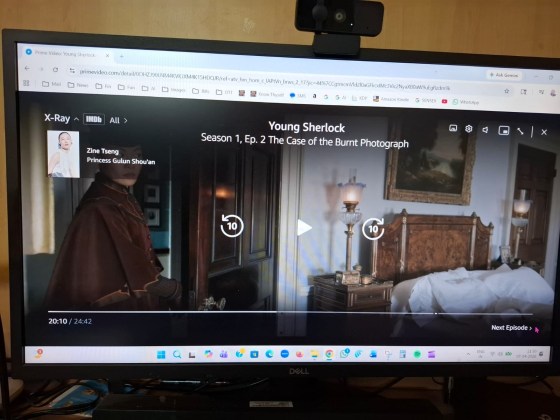
My Reply to My Brother On His OTT Recommendation of “Young Sherlock”
Dear Sac, Your recommendation is excellent. Mighty interesting. Set in Oxford, with all the literary allusions flowing in and the … More
Beyond the Golden Veil: Transcending Sattva, Para Vidya, and the Final Frontier of Self-Knowledge in Advaita
Of the three gunas that constitute all of manifest existence, Sattva — the quality of luminosity, harmony, and knowledge — is the most seductive bondage. Unlike Tamas, which crushes, or Rajas, which burns, Sattva seduces with bliss, ethical refinement, and the pleasures of understanding. Ramakrishna’s parable of the three robbers captures this with surgical precision: the sattvic robber alone unties the traveller and shows him the path home — but does not take him there. The finest veil is still a veil.
The Mundaka Upanishad’s distinction between Apara Vidya — all systematized human knowledge, from the sciences to the humanities — and Para Vidya, the knowledge by which the Imperishable is realized, frames this predicament with extraordinary clarity. No accumulation of apara vidya, however refined and sattvic, can answer the question the Upanishad’s Shaunaka poses at the outset: by knowing what does everything become known? That question dissolves the knower, and no object of knowledge can accomplish that.
Ramana Maharshi, Nisargadatta Maharaj, and J. Krishnamurti — approaching from different angles — converge on a single insight: the final obstacle to liberation is not ignorance or desire, but the subtle, luminous, deeply respectable self that knows.
“If You Meet The Buddha On The Road, Kill Him.”
Ninth-century Chinese Buddhist monk Linji Yixuan famously told his disciples, “If you meet the Buddha on the road, kill him.” … More
Nee illu Ekkado Telusa – “నీ ఇల్లు ఎక్కడో తెలుసా” || Telugu Folk Song
“నీ ఇల్లు ఎక్కడో తెలుసా?” — Do you know where your true home is? This powerful Telugu folk song cuts through life’s illusions with fearless honesty, addressing the restless human mind directly. You celebrate your house, your family, your wealth — but your real final home, the song reminds us, lies at the cremation ground. You arrived in this world with nothing, and you will leave with nothing.
The song urges the mind not to cling to spouse, children, or siblings — for on the day you depart, even your closest loved ones will hesitate to come near. It questions the endless wrestling over property and possessions, calling them asthi ramu — unstable, impermanent. Fame and status fare no better: “How significant are you in this vast universe? How far does your name really reach?”
Even the body you call your own will one day abandon you. Belonging to the Telugu Vairagya tradition of philosophical folk poetry — echoing saints like Vemana and Kabir — this song does not preach despair. It preaches awakening. Surrender to the eternal, unseen divine, it says, for in a life of total impermanence, that alone is real.
How AI Helped Me Make Peace with Science: A Journey Through Psychology, Medicine, and the Humanities
Why would anyone turn to AI to work through a psychological aversion to the natural sciences — or to process complicated feelings about medical school classmates they’d rather not see? The answer, it turns out, is stranger and more revealing than the question itself.
In this post, I reflect on an unexpected journey: using AI conversations to untangle a deep-seated psychological distaste — not just for medicine and biology, but for the whole constellation of natural sciences, from chemistry and physics to geology and astronomy. What began as an oddly specific inquiry into whether doctors are boring slowly became something far more personal: a reckoning with how our inner landscape distorts our perception of the outer world.
Perhaps the most unsettling insight is this — we don’t see fields of knowledge as they are; we see them as we are. Our psyche, in its quiet wisdom or its quiet woundedness, nudges us toward certain domains and away from others, not always by rational design but by emotional necessity. For those of us who needed the humanities and social sciences to feel whole, that detour wasn’t a failure of intellect. It was a form of healing.
 Know Thyself